


Air travel didn’t have to be this way.
I can still remember traveling in an era where carry-on and 70 pound checked bags were free, hot kosher meals were available even in domestic coach, and legroom was aplenty.
And then along came Spirit.
First, they raised eyebrows by only giving 1 free checked bag. All airlines provided 2 or 3 free checked bags, plus free carry-on bags, until that point.
And then they were proud to strip away everything that made air travel decent, with their ultra-low-cost carrier model and the “bare fare.”
You’d get a cramped hard seat with little legroom and no recline. You wouldn’t get any free carry-on, and if you wanted a checked bag, you’d pay for it, and it would be limited to a miserly 40 pounds. You wouldn’t get a free snack or even water. Forget about having in-seat entertainment or even power. If your flight was delayed or canceled, as many Spirit flights were, you were out of luck. They wouldn’t put you on another airline and their flights were often full, leaving you to have to pay another airline for a walk-up fare or wait for days to travel.
And yes, that model worked for some people and allowed some people to travel when they couldn’t otherwise afford to.
I’ve covered some Spirit fare sales for 2 decades now. $0.00 flights (yes, they were honored), BOGO, or 32 cent flights, anyone?
But a business model where you make travel as unpleasant as possible isn’t going to be a sustainable one, even if it is the cheapest way to travel.
Spirit didn’t have to go as extreme as it did. But by doing so, they made it easy for legacy airlines to compete with a better product at similar pricing, leaving them no breathing room.
Last year, I had a meeting where someone of means asked if they should buy Spirit Airlines to turn it around. I advised against it. The business model was broken, and the culture was radioactive.
The Spirit model caused the crapification of air travel for everyone.
Older legacy carriers had no choice but to join the race to the bottom and ruin their own product to compete with Spirit’s fares. That led to the elimination of free checked baggage and, eventually, the creation of the basic fare.
The Spirit bare fare couldn’t compete with the legacy carriers’ basic fare.
Spirit could offer miles, but that still meant the rewards were for flights on Spirit.
Spirit hasn’t made any money in years, and the low-cost carrier model is no longer viable. Southwest had to ditch it, and Frontier and JetBlue are also struggling to make any money.
Some of the nickel-and-dime race to the bottom is the government’s fault.
Airlines love baggage and other ancillary fees, as the government taxes them at a lower rate than they tax airfare. A simple fix would be for the government to fix that bug and level the playing field, but that has yet to happen. Fees will continue rising until that is rectified.
That led to the low-cost carriers charging a fee to book online, which can only be waived by booking travel at the airport.
To be fair, as with all the low-cost carriers, when Spirit entered a market, they made air travel dramatically cheaper for everyone.
But things don’t end well when there’s an adversarial relationship with your customers.
Like I always said. Friends Don’t Let Friends Fly Spirit (Or Frontier). Spirit’s inaccurate statements about their own customers and how they dealt with a week-long meltdown summed up that culture well. And it’s not a winning one.
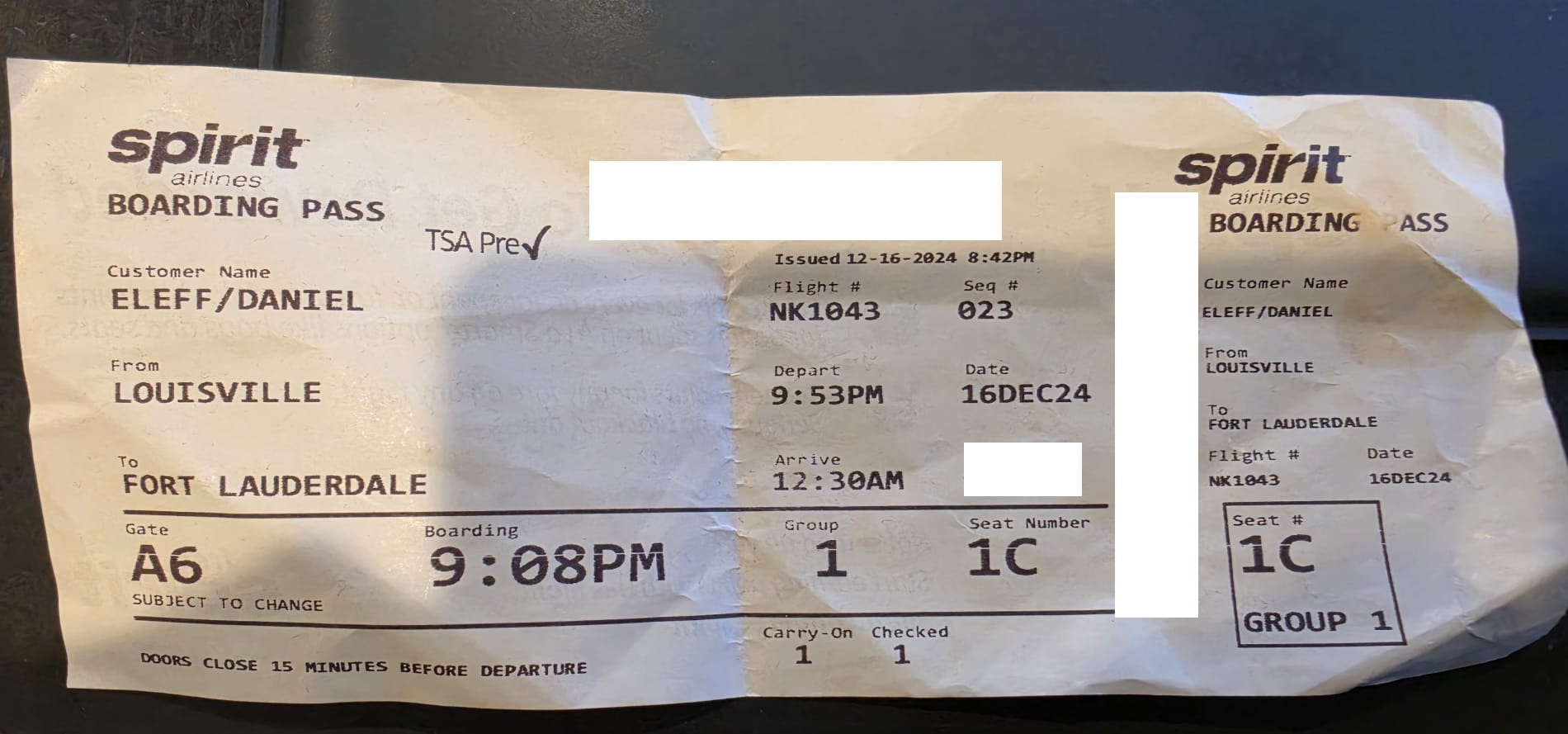
I did fly Spirit once. My brothers took me on a surprise trip on the Bourbon Trail for my 40th birthday, and they booked me a Spirit flight from Louisville to Fort Lauderdale afterward.
I guess that means JJ isn’t my friend? 😉
Thankfully, it was in the Big Front Seat, but everything from the inoperational bathroom in the front of the plane to the lackadaisical attitude from all of the employees to the cleanliness of the plane summed up why I didn’t need a repeat of the experience.
Sure, it got us from point A to point B. But I’d still rather use miles and fly another airline whenever possible.
Yes, this happened:
A Frontier and Spirit merger would have created an airline with greater scale to compete. Afraid of getting left behind, JetBlue stepped in with a stronger offer to buy Spirit. The Biden Administration’s DOJ and DOT successfully challenged that merger, and Spirit has bled out ever since.
Americans deserve robust competition & affordable airfares. USDOT supports DOJ’s antitrust lawsuit, & we plan to deny the JetBlue-Spirit request for an exemption on their merger deal. We will continue with our own investigation while supporting DOJ’s work. https://t.co/vs4Aqgdiru
— Secretary Pete Buttigieg (@SecretaryPete) March 7, 2023
It’s impossible to say if either of those mergers would have led to a more profitable airline or if we’d be looking at a larger airline going bust. It’s certainly easier to compete and find cost savings with more scale, but when you’re losing money on every ticket sold, you’re not going to make that up with volume.
Spirit tried pivoting models away from an ultra-low-cost carrier, but it was unsuccessful. That kind of rebranding is no easy feat, so it’s no surprise that it didn’t succeed.
High fuel costs expedited Spirit’s failure, but it was not responsible for the failure. The business model has been broken for years, and management had no idea how to turn a profit in a post-COVID world. That’s sad for their employees who are now out of work, but this is entirely Spirit’s fault.
And so, Spirit is now permanently grounded. Frontier and JetBlue may not be far behind unless they can figure out how to right their ships and compete with the legacy carriers soon.
Will you miss Spirit? Or are you saddened about what has happened to air travel as a whole because of Spirit’s policies?


![Calgary to Manzanillo, Mexico – $460 (CB) to $557 CAD roundtrip including taxes [Nonstop Flights]](https://i1.wp.com/www.ydeals.com/images/ydeals_logo_300x300.jpg?w=175&resize=175,175&ssl=1 "Calgary to Manzanillo, Mexico – $460 (CB) to $557 CAD roundtrip including taxes [Nonstop Flights]")


